ZimmWriter Alternatives Mistakes to Avoid When Picking a Direct WordPress Publishing Tool
Picking the wrong direct WordPress publishing tool can cost you weeks of rework. Some tools promise one-click publishing but still require copy-pasting every article, and credit limits can quietly cap your scaling plans.
By the end of this article, you will know the five mistakes to avoid when choosing a ZimmWriter alternative, from ignoring how a tool actually publishes to WordPress to paying for features you will never use. You will also see how Autoblogging.ai fits into a practical workflow and who should look elsewhere.
What Is Autoblogging.ai and How Does It Publish Directly to WordPress?
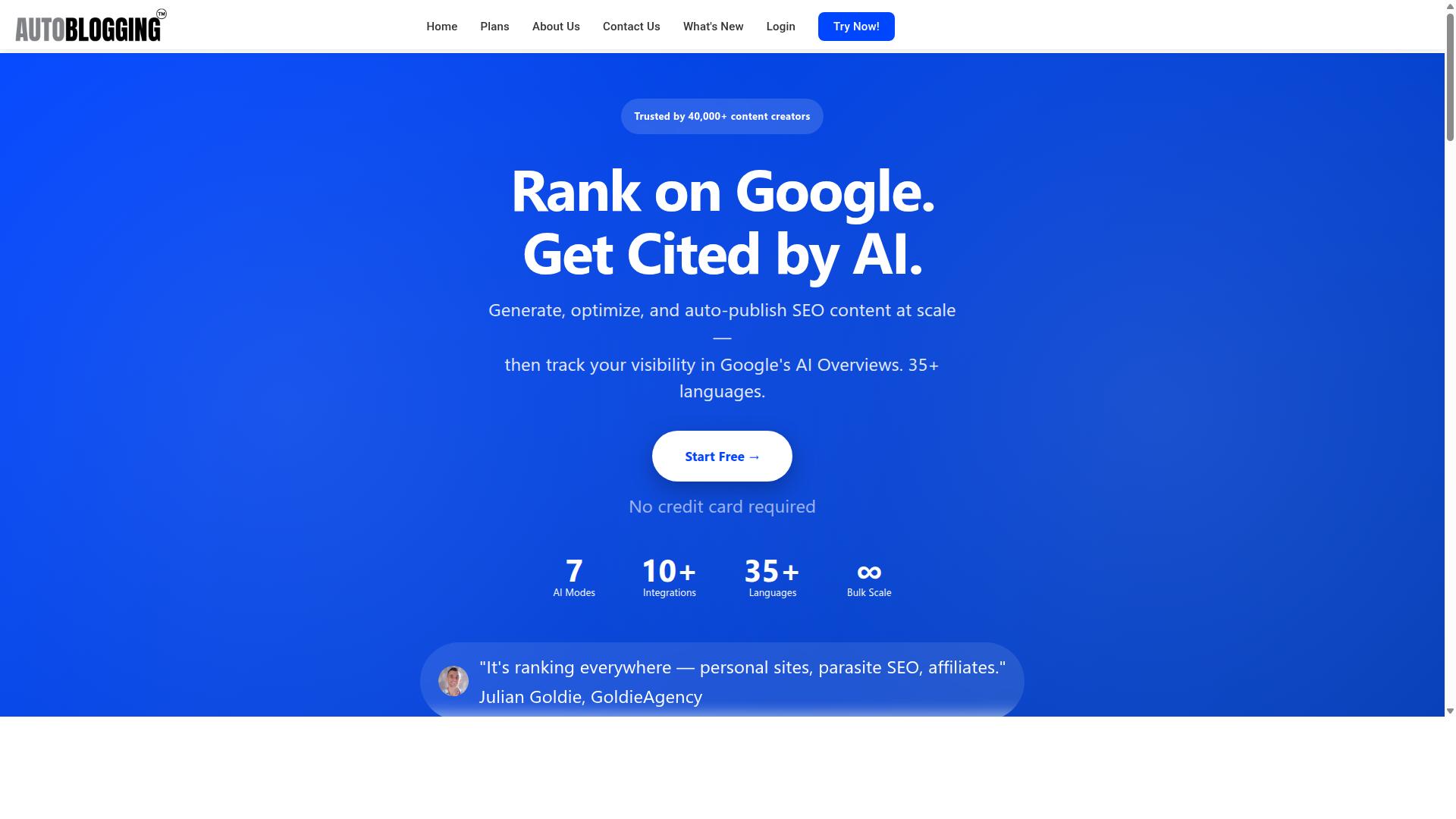
Autoblogging.ai is an AI-powered content automation platform that generates and publishes articles directly to WordPress, eliminating the need for manual copy-paste workflows. It is a SaaS tool built for bloggers and agencies that want consistent output without babysitting every post.
On the publishing side, it connects to WordPress through a plugin or an API connection, with one-click publishing and scheduled auto-posting across unlimited sites. That direct link matters because copy-paste publishing breaks down fast at volume. Formatting drifts, featured images get skipped, and draft management turns into a chore.
With direct publishing, an article moves from generation to your site in a single step. You keep control over when it goes live, and the workflow stays consistent whether you run one blog or a portfolio of client sites.
Who Autoblogging.ai Serves: Bloggers, Agencies, SEOs and Affiliate Marketers
Autoblogging.ai is built for a diverse set of content creators, including individual bloggers, marketing agencies, SEO professionals, and affiliate marketers who need to scale content production. Each group has a different reason for caring about direct WordPress publishing.
Bloggers and website owners need a steady publishing rhythm. Direct publishing removes the manual step between finishing an article and getting it live, which keeps a personal site or local site active without daily hands-on effort.
Agencies manage multiple client websites, plus portfolio sites and parasite SEO properties. Publishing to unlimited WordPress sites from one platform keeps client work moving and helps maintain consistent formatting across every domain.
SEOs often need content in volume for campaigns. Bulk Generation supports up to 500 articles via CSV, and scheduled auto-posting spreads those pieces out instead of dumping them all at once.
Affiliate marketers lean on product-focused content. Amazon Reviews Mode is built for that angle, and direct publishing keeps review posts flowing to affiliate sites without a copy-paste bottleneck.
The common thread is scale. Whether the goal is one blog or a client roster, direct publishing turns content automation into a repeatable workflow rather than a manual routine.
Why the Wrong ZimmWriter Alternative Choice Costs You Time and Rankings
Choosing a ZimmWriter alternative without evaluating how it publishes to WordPress can lead to hours of manual work and missed SEO opportunities. That single oversight, whether the tool connects through the REST API, an application password, or XML-RPC, often decides whether content automation actually saves you time or quietly adds another job to your week.
The cost rarely shows up as one dramatic failure. It accumulates in small, repeated tasks: copying drafts, pasting them into the Gutenberg editor, fixing broken formatting, and uploading featured images by hand. Individually these steps take minutes. Multiplied across a publishing schedule, they consume entire workdays.
Consider a blogger publishing five articles a week. If each piece needs manual uploading, formatting cleanup, and image placement, that time adds up quickly. Over a year, that is hundreds of hours diverted from research, outreach, or content strategy.
Time is only part of the problem. The wrong tool selection also creates inconsistent formatting across your site. Headings arrive in the wrong hierarchy, lists break, and HTML sanitization strips elements you wanted to keep. Readers notice messy layouts, and search engines reward clean structure.
Missed publishing schedules compound the damage. Search rankings respond to freshness and consistency, so a site that publishes erratically loses momentum against competitors who post reliably. When manual uploads pile up, scheduled posting slips, and gaps between posts widen.
Tool selection also affects the technical details that support SEO best practices:
- Slug optimization and canonical URL handling
- Meta description population
- Category, tag, and taxonomy assignment
- Internal linking and anchor text placement
- Featured image and custom post type support
A tool that skips these details forces you to fix them afterward. A tool with genuine WordPress integration handles them as part of the publishing workflow, so bulk article creation does not create bulk cleanup.
Authentication and permissions matter too. A reliable alternative uses secure methods like an application password or REST API connection, and it respects user role permissions and draft management. Without that, you either expose your site to risk or spend time approving and repairing every post.
The practical test is simple. Before committing, ask how the tool publishes: does it push directly to WordPress, does it preserve editor compatibility, and does it respect your formatting? The right choice turns content automation into a genuine time saver. The wrong one turns it into a second job.
Mistake #1: Ignoring How the Tool Actually Publishes to WordPress
Many users assume all AI writing tools publish to WordPress the same way, but the method-whether via API, plugin, or XML-RPC-drastically affects your workflow. This is one of the most overlooked factors when comparing ZimmWriter alternatives, and it often only becomes obvious after you have already committed to a tool.
Some platforms stop at content generation. They hand you a finished article, and everything after that point is your job: opening WordPress, creating a new post, pasting the text, cleaning up stray formatting, and rebuilding the structure by hand. Others connect directly to your site and handle the publishing step for you.
That gap matters more than most buyers expect. A tool with excellent writing quality but no publishing path can still cost you hours every week. Meanwhile, a tool with a direct WordPress integration turns a multi-step chore into a single action.
When evaluating any ZimmWriter alternative, check the publishing method before you check anything else. Ask how the tool authenticates with WordPress, whether it supports scheduled posting, and whether it can handle drafts, categories, and featured images. The answers determine whether you are buying content automation or just a faster text generator.
This is also where tool selection gets practical. A writer who publishes a few posts a month may tolerate copy-paste. Someone running bulk article creation across several sites cannot. The publishing mechanism decides which group you fall into.
One-Click Publishing vs. Copy-Paste Workflows
One-click publishing eliminates the need to manually copy content from the AI tool and paste it into WordPress, a process that is error-prone and time-consuming. The two workflows look similar on a feature list, but they feel completely different in daily use.
A copy-paste workflow typically involves several stages. You generate the article, copy the text, open the WordPress editor, paste it in, then fix whatever broke during the transfer. Headings may lose their hierarchy, lists may collapse, and extra spacing or stray characters often appear. After formatting, you still need to add a featured image, assign categories and tags, write a meta description, and set a slug. Do that for every post and the manual work adds up fast.
One-click publishing works differently. You connect the tool to your site, then publish or schedule directly from the tool. There is no intermediate clipboard step, so formatting stays intact and nothing gets lost in translation.
The advantages are consistent:
- Time savings. Publishing becomes one action instead of a five-step routine.
- Fewer errors. No broken headings, missing images, or mangled HTML from pasting.
- Better scheduling. Posts can go out on a set cadence without manual intervention.
- Cleaner draft management. Content arrives as a draft or live post, ready for review.
Autoblogging.ai supports direct publishing to WordPress, with unlimited sites, one-click publishing, a plugin option, and scheduled auto-posting. That combination means content can move from generation to your site without a manual transfer step, which is exactly the kind of workflow a direct publishing tool should provide.
For anyone weighing a ZimmWriter alternative, the takeaway is simple. Check whether the tool publishes for you or just writes for you. That single distinction shapes your entire publishing workflow and determines how much of your time goes to content versus cleanup.
Mistake #2: Assuming Every Tool Handles SEO Research for You
Not all AI writing tools include built-in SEO research, and assuming they do can result in content that fails to rank. This is one of the most expensive assumptions when comparing a ZimmWriter alternative that publishes directly to WordPress.
Ranking well requires more than clean prose. It requires understanding who already ranks, which related terms those pages use, and how search engines connect your topic to broader entities. SEO research is the foundation, and it happens before a single word is generated.
Many tools skip this step entirely. They generate text from a prompt and leave the research to you. That means extra subscriptions, manual SERP checks, and hours spent compiling keyword lists in separate documents.
There is also a workflow cost. When research lives outside the writing tool, insights get lost in translation. The article ships without the supporting terms and structure that would have helped it compete.
Before committing to any tool, ask a direct question: does it analyze the search results for my target keyword, or does it only write? The answer separates a true SEO content generator from a generic text spinner with a publishing button.
Budget matters here too. A cheap writing tool plus three research subscriptions often costs more than a single platform that handles both. Factor that into your comparison before you decide.
SERP Competitor Analysis, LSI Keywords and Knowledge Graph Extraction
Autoblogging.ai's Godlike Mode performs SERP competitor analysis, extracts LSI keywords, and leverages knowledge graphs to generate content that aligns with search intent. This is the difference between writing about a topic and writing to rank for it.
The process starts with the pages already competing for your keyword. Godlike Mode examines those top-ranking results to understand what search engines currently reward for that query. From there, it identifies LSI keywords and entities that give the article topical depth rather than surface-level coverage.
Knowledge graph extraction adds another layer. Instead of treating a keyword as an isolated phrase, the tool connects it to related concepts and entities. An article about a broad topic can naturally include the supporting terms and structured context that search engines associate with genuine expertise.
Contrast that with tools that lack these features. Users of those platforms must open separate research tools, pull competitor headings manually, and guess which related terms matter. The research is doable, but it is slow and easy to skip under deadline pressure.
Autoblogging.ai supports this research within a broader platform. Quick Mode offers a free entry point for single articles and a wizard flow. Godlike Mode handles the deeper SEO-driven generation. Bulk Generation can produce up to 500 articles via CSV when you need volume.
The SEO tooling extends past generation. Semantic SEO Analysis runs a 21-point audit, Snippet Optimizer targets featured snippet formatting, and Topical Maps help plan coverage across related subjects. Site Optimizer and Intense Optimizer round out the optimization set.
Publishing ties it together. WordPress integration supports unlimited sites through a plugin, one-click publishing, and scheduled auto-posting. Content can also flow to Medium, Dev.to, Hashnode, Telegraph, and Tumblr, plus platforms like Shopify, Wix, Webflow, Blogger, and Ghost, or through the API, Zapier, and n8n.
The practical takeaway is simple. If a ZimmWriter alternative leaves SEO research entirely to you, you are not choosing a publishing tool. You are choosing a writing tool plus a second job. Autoblogging.ai folds that research into the generation step, which is exactly where it belongs.
Mistake #3: Overlooking Content Volume Limits and Credit Systems
Many users choose a tool without checking its content volume limits or credit system, only to hit a wall when they need to scale. The problem rarely shows up on day one. It appears weeks later, when a campaign needs 200 articles and the plan quietly caps you at a fraction of that.
Credit systems vary widely across direct WordPress publishing tools. Some limit the number of articles per month. Others restrict specific features, such as bulk article creation, even when you still have credits left. A few expire unused credits at the end of each billing cycle, which means slow months cost you the same as busy ones.
For anyone comparing a ZimmWriter alternative, this is where tool selection gets expensive. If your publishing workflow depends on steady output, a hard monthly ceiling can stall scheduled posting, starve internal linking campaigns, and leave new sites with thin archives.
Before committing, check three things:
- How many articles you can generate in a single run, not just per month
- Whether unused credits carry over or expire
- Whether bulk generation is included or treated as a premium add-on
Overlooking these limits does not just slow you down. It forces a mid-campaign migration to another SEO content generator, which means rebuilding your WordPress integration, API connection, and publishing workflow from scratch.
Bulk Generation, Credit Rollover and What 500 Articles per Run Means for Scaling
Autoblogging.ai allows bulk generation of up to 500 articles per run and offers credit rollover, enabling agencies and bloggers to scale content production without waste. Bulk Generation accepts a CSV, so a single run can populate a brand new site or refill a content calendar in one pass.
The 500 articles per run figure matters most for agencies and multi-site operators. An agency managing 10 client sites can generate 50 articles per site in one run, which keeps every property moving without ten separate sessions. Populating a fresh WordPress install with a full category structure becomes a scheduling task rather than a months-long project.
Credit rollover solves the other half of the problem. Unused credits carry over to the next month, so a quiet period does not destroy value you already paid for. Compare that to tools with strict monthly limits, where unused capacity simply disappears and a busy month leaves you buying top-ups.
Combined with one-click WordPress publishing, scheduled auto-posting, and unlimited site connections, bulk generation keeps the publishing workflow continuous. The limits you accept at signup shape what your content automation can actually deliver six months in.
Mistake #4: Skipping the Human Review Step in Your Workflow
Even the best AI content can benefit from a human review, and skipping this step can lead to factual errors or brand voice inconsistencies. When you pick a ZimmWriter alternative for direct WordPress publishing, it is tempting to treat the tool as a fully autonomous system. You set up the API connection, configure the plugin compatibility, and let bulk article creation run on autopilot. That approach saves time, but it also removes the one checkpoint that catches problems before your audience sees them.
AI writing software generates text by predicting likely word sequences. It does not verify claims against a source of truth. That means a model can hallucinate a statistic, misattribute a quote, or invent a product detail that sounds completely plausible. Grammar and structure usually hold up fine, which makes the errors harder to spot at a glance. A confident, well-formatted paragraph can still contain a fabricated fact.
The risk grows sharply on YMYL topics, which stands for "your money or your life." Health advice, financial guidance, legal explanations, and safety instructions all fall into this category. A wrong dosage, an outdated tax rule, or a misstated legal deadline can cause real harm to a reader and real reputational damage to your site. Search quality raters also apply stricter standards to these subjects, so an unreviewed error carries more weight than it would on a hobby blog.
Brand-sensitive content deserves the same caution. Tone, terminology, and positioning are easy to get subtly wrong. An AI model might describe your service with language a competitor would use, or miss an internal naming convention your team follows. Readers notice when a post does not sound like the rest of your site. Consistency is part of trust.
A simple workflow solves most of this. Generate with AI, review and edit, then publish. Treat the draft stage as raw material rather than a finished product. The publishing workflow inside a direct WordPress tool should support this sequence naturally, with draft management that holds content until a person approves it.
- Generate: let the SEO content generator produce the full draft, including headings, body copy, and meta description.
- Review: check facts, names, numbers, and any claim that could be verified.
- Edit: adjust tone, tighten phrasing, and confirm internal linking and anchor text read naturally.
- Publish: push the approved version live, or schedule it for a later slot.
Some platforms build a human proofreading stage directly into the pipeline, which keeps the checkpoint from being skipped when volume rises. Others work together with your existing editing process, so drafts land in a review queue instead of going straight to the live site. Either setup works, as long as the review step is a required stage rather than an optional one.
User role permissions matter here too. If every account can publish without restriction, review becomes a suggestion. Configure roles so that contributors and authors can create and edit drafts, while editors or administrators hold the publish permission. That single setting enforces the workflow without anyone needing to remember it.
Review does not have to be slow. Focus your attention where errors are most costly and most visible:
- Introductions and conclusions: these carry the main claim and the takeaway, so a wrong statement here misleads the most readers.
- Numbers and dates: statistics, prices, deadlines, and version numbers are the most common hallucination targets.
- Names and titles: verify people, products, and organizations are spelled and described correctly.
- Headings and meta description: these shape click-through and search snippets, so they should match the body copy exactly.
- Links: confirm internal linking targets exist and external linking points to pages that still load.
Formatting deserves a quick pass as well. Check that HTML sanitization did not strip anything important, and that the post renders correctly in the Gutenberg editor or the classic editor, whichever your site uses. Confirm the featured image, categories, tags, and any custom post types are assigned as intended. A slug optimization check and a canonical URL check take seconds and prevent duplicate-content confusion later.
None of this undermines content automation. It makes automation safe to scale. A tool that handles API connection, scheduled posting, and bulk article creation removes the manual labor. A human review removes the risk. Together they produce a publishing workflow that is both fast and dependable, which is the whole point of choosing a direct WordPress publishing tool in the first place.
Mistake #5: Paying for Features You Will Never Use
Many AI writing tools bundle features that sound impressive but go unused, inflating your monthly costs unnecessarily. A solo blogger publishing a handful of posts each week does not need the same plan as an agency running bulk article creation across dozens of client sites.
This is one of the most common tool selection errors. Buyers compare feature lists side by side, pick the longest one, and then pay every month for capabilities that never touch their publishing workflow.
Before you commit to any plan, audit what you actually need. Ask yourself a few direct questions:
- Do you need bulk article creation, or just a steady trickle of posts?
- Do you publish in multiple languages, or only one?
- Do you require advanced SEO content generator options, or basic meta description and internal linking support?
- How many articles per month does your scheduled posting calendar actually require?
Once you have honest answers, match the plan to the volume. Paying for 5,000 credits when you generate 30 articles a month is money wasted, and that overspend repeats every billing cycle. The right approach is to start at the tier that fits your current output, then scale up only when your publishing workflow genuinely demands it.
Autoblogging.ai Pricing: $19 to $999 Monthly, With Annual Discounts
Autoblogging.ai offers monthly plans ranging from $19 for 40 credits to $999 for 5,000 credits, with annual discounts available. Credits are used per article generation, so your plan choice should track directly to how much content you produce.
| Plan | Monthly Price | Credits |
|---|---|---|
| Starter | $19 | 40 |
| Regular | $49 | 120 |
| Standard | $99 | 300 |
| Gold | $179 | 600 |
| Premium | $249 | 1,000 |
| Enterprise | $999 | 5,000 |
Annual billing lowers the effective rate across every tier. Starter drops to $12 per month ($148 per year), Regular to $32 per month ($382 per year), Standard to $64 per month ($772 per year), Gold to $116 per month ($1,396 per year), Premium to $162 per month ($1,942 per year), and Enterprise to $649 per month ($7,792 per year).
Matching a plan to your real output is straightforward. A solo blogger running a single site might only need Starter, while an agency managing bulk article creation for multiple clients would fit Enterprise. Everyone in between can pick a middle tier that reflects actual monthly volume rather than aspiration.
Two details soften the commitment. All plans include credits rollover, so unused credits are not lost when a quiet month follows a busy one. New accounts also receive 10 free credits per month with no credit card required, which lets you gauge real output before paying. Additional credits are available for purchase if you occasionally exceed your tier, and you can cancel anytime.
The lesson ties back to the mistake: choose the tier that matches your publishing workflow today, not the one with the longest feature list. That keeps your content automation costs honest and leaves room to upgrade when your volume truly grows.
Trust Signals: 40,000+ Users, 1M+ Articles and a 4.9 Average Rating
Autoblogging.ai is trusted by over 40,000 content creators and has generated more than 1 million articles, with a 4.9 average rating. Those numbers matter when you are choosing a direct WordPress publishing tool, because they reflect a platform that has already survived real-world use at scale.
When a service handles bulk article creation for tens of thousands of people, it has been tested against every kind of WordPress integration: REST API connections, application passwords, plugin compatibility, and the quirks of the Gutenberg editor versus the classic editor. A smaller or newer tool simply has not faced that range of publishing workflows yet.
The 1M+ articles generated figure speaks to scalability and output consistency. Anyone can produce a handful of decent posts. Producing over a million while maintaining a 4.9 average rating suggests the tool holds up under repeated, high-volume use, which is exactly what matters for scheduled posting and bulk article creation.
Expert endorsements add another layer. Testimonials from industry figures like Julian Goldie and James Dooley carry weight because these are people whose audiences depend on their recommendations being accurate. Their backing validates that the platform delivers on its core promise rather than just marketing well.
For anyone weighing a ZimmWriter alternative for direct WordPress publishing, these trust signals should sit alongside the technical checklist. A large user base indicates reliability, high article volume shows the system scales, and expert validation confirms effectiveness in practice.
Autoblogging.ai also supports 10+ AI modes, 35+ languages, and 35+ integrations, with a human proofreader included in all plans and 24/7 support. Combined with a 4.9 average rating, that track record makes it a credible, established choice rather than an untested gamble.
Who Should Use Autoblogging.ai - and Who Should Look Elsewhere
Autoblogging.ai is ideal for bloggers, agencies, and affiliate marketers who need to scale content with direct WordPress publishing and advanced SEO features. The platform was built for people who treat content as a production pipeline, not a one-off task.
If you are weighing it against ZimmWriter or any other alternative, the real question is not which tool is "best" in the abstract. It is whether your workflow and volume match what the tool was designed to do.
Autoblogging.ai fits you well if:
- You manage multiple websites, whether personal sites, affiliate sites, client websites, portfolio sites, or local sites
- You need bulk article creation rather than writing one post at a time
- You want a direct WordPress publishing path instead of copying and pasting from a separate editor
- You run content operations for clients as a marketing agency or SEO professional
- You practice parasite SEO or build out large affiliate content libraries
- You are a content creator or website owner who values an SEO content generator that handles scale
These users share one trait: content volume is a bottleneck, and manual publishing eats hours that could go into strategy, link building, or client work.
Autoblogging.ai may not be the right fit if:
- You are a hobbyist publishing a handful of posts per month, where a lighter tool or manual writing is enough
- You want full manual control over every word and would rather edit each sentence yourself
- You enjoy writing as the main activity and do not want automation in the loop at all
None of these are flaws in the tool. They are simply mismatches between what a platform is designed for and how you prefer to work.
One practical point for anyone comparing options: Autoblogging.ai serves global users and offers 24/7 support. For agencies and site owners working across time zones, that matters when a publishing workflow breaks at an inconvenient hour.
The honest takeaway is this. If your goal is to scale content across one or many WordPress sites with less manual publishing effort, Autoblogging.ai is built for exactly that. If your goal is to handcraft every paragraph at low volume, you will get more value from a simpler setup. Match the tool to the job, and you avoid the most common mistake in tool selection: buying for the wrong workflow.
Final Verdict: Avoiding These Mistakes Starts With the Right Tool
Avoiding the five mistakes outlined in this article begins with choosing a tool that publishes directly to WordPress, handles SEO research, and scales with your needs. Most problems people run into with ZimmWriter alternatives trace back to the same root causes: a shaky publishing workflow, thin SEO features, unclear volume limits, skipped human review, or pricing that punishes growth.
If you fix those five areas during tool selection, you sidestep the majority of headaches before they start. Here is a quick recap of what to check before you commit.
- Publishing method: Confirm the tool connects to WordPress directly, whether through the REST API, an application password, or a plugin, rather than relying on manual copy and paste.
- SEO features: Look for meta description handling, internal linking, slug optimization, and support for featured images, categories, and tags.
- Volume limits: Check how many articles you can generate per month and whether bulk article creation is included or capped.
- Human review: Keep an editing step in your publishing workflow so drafts pass through review before they go live.
- Pricing: Match the plan to your actual output, not to a demo that hides usage ceilings.
Autoblogging.ai was built around these exact pain points. It publishes directly to WordPress, removing the export and re-upload cycle that breaks formatting and wastes hours. Its Godlike Mode and bulk generation features support larger content operations without forcing you to babysit every article.
Pricing stays flexible, so you can start at a level that fits your current output and adjust as your needs change. For anyone weighing ZimmWriter alternatives, that combination of direct WordPress publishing, SEO-aware generation, and scalable volume addresses the mistakes covered above rather than repeating them.
If you have questions before choosing a plan, reach out and the team can help you decide. You can contact Autoblogging.ai by email at [email protected], by phone or WhatsApp at +91 84605-06553, or on Skype at vibes.yb. Support hours are 7:00 to 19:00 IST.
Office locations include 501, Trinity Orion, Vesu, Surat - 395007, Gujarat, India, and 2nd Flr, SEO Content Suite, 35 Water Ln, Wilmslow, Cheshire SK9 5AR, United Kingdom. You can also follow updates on Facebook, Twitter, and LinkedIn. The verdict is straightforward: pick a tool that publishes directly, researches properly, and grows with you, and the mistakes in this article never get a chance to happen.
Frequently Asked Questions
What should I check first before switching from ZimmWriter to a direct WordPress publishing tool?
Before switching, confirm the tool can publish directly to WordPress without fragile workarounds, and that it fits how you actually create content. Autoblogging.ai is built as an AI article generation platform with direct publishing workflows, so you can generate and push content from one place instead of stitching tools together. Start by listing your must-haves (modes, languages, integrations, credits) and test them during a trial rather than after you've committed.
Is it a mistake to pick a tool based only on its cheapest plan?
Yes - the cheapest tier often limits credits, modes or bulk features you'll need as soon as you scale. Autoblogging.ai uses a credit-based system with monthly plans ranging from Starter at $19 (40 credits) up to Enterprise at $999 (5,000 credits), plus annual options, so you can match the plan to your real output. Estimate your monthly article volume first, then choose the tier that covers it without constant top-ups.
Why does direct WordPress publishing matter compared to copy-pasting articles?
Copy-pasting breaks your workflow, invites formatting errors and slows down publishing at scale. A direct publishing tool lets you generate and send articles to WordPress in a streamlined flow, which is exactly the kind of time-saving automation Autoblogging.ai is designed for. If a tool can't publish cleanly to WordPress, you'll pay for it later in manual cleanup.
How many articles should a direct publishing tool be able to handle at once?
It depends on your use case, but bulk capability is a common blind spot when comparing tools. Autoblogging.ai supports Bulk Generation of up to 500 articles via CSV, which suits agencies and portfolio or affiliate site owners managing multiple properties. If you only publish a few posts a month, a lighter mode may be enough - just don't buy a tool that caps out before you scale.
Should I worry about language and integration support when choosing a tool?
Absolutely - limited language or integration support becomes a wall once you expand to new markets or connect other services. Autoblogging.ai supports 35+ languages and 35+ integrations, so it can fit global projects rather than forcing you into English-only publishing. Check that your target languages and the tools you rely on are covered before committing.
What ongoing costs or limitations do people overlook?
People often forget about credit expiry, support quality and how quickly new features ship. Autoblogging.ai includes credits rollover, 24/7 support and ships new features weekly, which reduces the risk of outgrowing the tool. It's also trusted by 40,000+ content creators with a 4.9 average rating and 1M+ articles generated - useful signals, but still verify the specifics against your own workflow.